
Ponies, Pearls and Power: Final Part Chinese and European Sources: A Wider Indian Ocean Perspective
 By Afeef Ahmed
The broader Indian Ocean world also took note of the Tibi family’s activities, as shown by Chinese imperial records and European travelogues. As mentioned, Marco Polo provides an outsider’s glimpse around 1293. In addition to noting Ma’bar’s horse imports, Polo specifically records that an ambassador (‘Chāmalittin’) from "the Sultan of Ma bar" arrived at the court of Kublai Khan in the 1280s. This indicates that the Mongol Yuan rulers were in communication with South India, and that Jamal al-Din acted as an intermediary, effectively representing the Pandya realm (or at least the Muslim faction of it) to the Chinese emperor. Indeed, Persian historians like Waşşaf and Rashid al-Din had highlighted that the Tibis enjoyed far-flung connections; Polo’s narrative confirms one such connection in action.
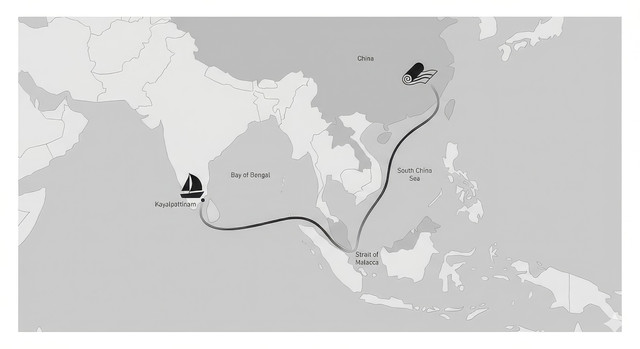
Even more direct evidence of Tibi involvement comes from the Chinese side. The Yuan Shih (Yuán Shĩ), the official History of the Yuan Dynasty, recounts an episode during Kublai Khan’s reign involving an emissary to South India. A Chinese general and envoy, Yang Tingbi, was sent by the Yuan court by sea to Ma’bar (Mábólů, i.e. the Tamil coast) around the late 13th century. According to Yuan records, Yang Tingbi met with a local dignitary named Mayindira (or Ma-yin-t’e-erh, likely a Chinese transcription of a name like Mayindirraja or similar) who was a judge and subordinate of the Pandya king Sundara.
The Chinese account relates a fascinating incident: Mayindira expressed to the Chinese envoy his willingness to submit to the Yuan emperor, and he claimed that "he had already sent the Iraqi merchant Jamal al-Din al-Tibi as envoy to China" (M. Mukai and F. Fiaschetti, 2020 p. 90). In other words, a local official in Ma bar told Yang Tingbi that Jamal al-Din Tibi had already traveled to China as an ambassador on behalf of (at least a faction of) the kingdom. This is a remarkable independent confirmation from Chinese sources that Jamal al-Din Tibī himself visited the Yuan court—presumably leveraging his status as both a merchant and a power-broker. It also shows us the afore-mentioned tensions and contestations existed in the period in the region, leaving us to assumptions of fragmented sovereign claims and contestations over power. The function of an envoy, often in these moments, would be to gain legitimacy and support from a foreign power, which could have been Jamal al-Din’s function.
The Yuan Shih account continues with political drama: when the Pandya monarch Sundara Pandya learned of Mayindira’s unauthorized attempt to pledge allegiance to the Yuan (and of Jamal al-Din’s mission abroad), he considered it an act of treasonous rebellion. Sundara ordered Mayīndira’s execution as punishment. However, Mayīndira managed to escape the sentence and fled, seeking military assistance from the Yuan Empire. The Chinese records thus reveal a fracture within the Pandya polity: a local Muslim-aligned official (and perhaps a faction of the court) was inclined to cooperate with the distant Mongol-Chinese power, even dispatching Jamal al-Din Tibi as an envoy to Beijing, while the reigning Hindu sovereign perceived this as betrayal and moved violently against the collaborators. This precisely mirrors the pattern suggested by Persian chronicles of Jamal al-Din operating quasi-independently and even against the interests of ‘the’ Pandya line, if there was one ‘single’ power concentration.
Scholarships in both Euro-America and Asia have begun to integrate these Chinese sources. Historian Tansen Sen, for example, provides a detailed discussion of Yang Tingbi’s mission and the Ma bar incident.
He notes that the Yuanshi corroborates the timeline that "the Northern [Delhi] invasion happened during [ongoing] civil disputes and political inconsistencies" in Ma’bar. In other words, by the time the Delhi Sultanate seriously attempted to conquer the far south (early 14th century), the Pandya country was already fragmented by internal strife, a situation exploited by actors like the Tibīs, and which ultimately made the region an easier target for external takeover. The Yuan records bolster Sastri’s and others’ claims of an inconsistent interregnum between Pandya and Sultanate rule. This narrative also questions the assumed seamless coherence of a conquest narrative, often hailed by South Indian historians of Tamilnadu including the likes of S.K Aiyangar. This also suggests that the conquest was not an attempt of taking or transferring power from an existing, powerful and centralized sovereign but rather an occasional instance of looting a wealthy region, fragmented by political inconsistencies.
Taken together, the Persian, Chinese, and European accounts all point to the same conclusion: the late 13th/early 14th-century ‘Pandya state was not a unitary, centralized kingdom but a porous arena of contestation, in which mercantile magnates could wield kingly power. The "genealogy of graves" in Kayalpattinam—that is, the inscriptions and tombs of Jamal al-Din and his kin—are physical testimonies to this brief period of merchant sovereignty. The tombstone inscription of 1337 CE, properly understood, memorializes Jamāl al-Din Tibi as a patron and ruler in Kayalpattinam, even as mainstream histories forgot him under the later narrative of the Madurai Sultanate. If we are to believe the Persian accounts, there was a period of interregnum between the last strong Pandiya ruler and the northern invasion. It is also important to re-interrogate the invasion by Malik Käfür as Nilakanda Shastri asks us to do- that it was just an addition to the confusion to the country which was ‘already distracted by civil wars’, and logically more petty sovereigns. The epigraphical evidence that refers to the Pandiyan brothers’ existence even after the invasion asks us to think in the similar lines. Khusraw’s account, like any other accounts of courtly poetry, has to be historicised, as Romila Thapar has shown us while analysing the Turko-Persian narratives of the sacking of Somnath (Thapar, 2004).
These accounts show us how the popularly perceived centralised notion of sovereignty in the state, at least in the coastal belt, was not as thorough as it was presented. Rather, it was porous on many levels that powerful trade magnates like Tibi could operate on their own will to an extent and could even climb up to the power later, even by dismissing the descendent claims of local sovereigns, as Marco Polo’s account shows. Further, Thomas. T. Allsen, the prominent Mongol historian notes how Ma’bar, though being one of the only kingdoms among "all the foreign nations across the seas that is capable of commanding other kingdoms" (Sen, 2006 p.308), had a kind of joint rulership, where the attributes of Prince can be considered as a ‘shorthand for malik-al tujjar, the "prince of traders," which further shows the overlaps between ‘imārat’ and ‘tijārat’ in the region, an idea which has already been explored by Anas Babu (Babu 2025). In reassessing the case of Kayalpattinam, we uncover a nuanced picture of trade and polity intersecting in medieval South India. The evidence from tombstone/epigraphic inscriptions, when expanded and cross-checked with Persian chronicles, Chinese dynastic histories, and European travelogues, reveals that the Tibi brothers (Jamal al-Din and Taqī al-Din) rose from wealthy traders to become an important political presence on the Coromandel Coast. Their story exemplifies what recent scholarship has conceptualized as the tijärat-imārat interplay the fusion of mercantile enterprise and political authority.
In a recent study, Anas Babu (2025) applies Sanjay Subrahmanyam’s framework of tijārat (commerce) and imārat (state-building) to argue that Asian merchants often played a major role in shaping state power. Rather than merely reinforcing these categories in a different temporal-spatial terrain, this was an attempt to argue that the specific nature of sovereignty that existed in South India at that time facilitated the smooth interplay of these categories. Then only we will be able to uncover the contexts enjoying privileged access and even political office as a matter of "planned convenience" rather than as an anomaly. What happened in Kayalpattinam around 1300 was an early demonstration of this phenomenon.
The sovereignty that existed in the Pandya Kingdom’s twilight was highly fragmented, with overlapping claims and multiple centers of power (Pandya princes, Tibi merchants, etc.). This environment enabled a trader like Jamal al-Din to smoothly transition into a major political player, without the stark division between ruler and merchant that colonial-era narratives often presume. As we have seen, the Tibis operated almost as partners to the Pandya crown initially, controlling revenue farms, military resources, and diplomatic channels, and later supplanted it entirely in the local power structure.
Ultimately, the Delhi Sultanate’s invasions and the subsequent establishment of the Madurai Sultanate (1330s) wiped away the Tibīs’ political legacy, ushering the Tamil coast into a different chapter of imperial rule. Yet, the traces of that legacy remained etched in stone. The Kayalpattinam mosque inscription of 1337 is one such trace, an epitaph that encodes the memory of a merchant-turned-sultan and his son. Reading it alongside the chronicles of Wassaf, Rashid al-Din, Barani, the Yuan Shih, and even Marco Polo’s memoirs, we gain a fuller genealogy of that material, a lineage of events and influences that situates a small coastal town in the currents of world history. Crucially, this case study invites us to reconsider the nature of sovereignty in pre-modern South India. We find that the ostensibly centralised Pandya state was in fact quite permeable, at least on its maritime flank. Powerful foreign traders like the Tibis could "operate on their own will to an extent," even usurping authority and dismissing the hereditary claims of local sovereigns when circumstances allowed. Marco Polo’s observation that "the Prince of this country" had sent an envoy to the Great Khan hints that the "prince" might well have been a merchant-prince. Mongol historian Thomas T. Allsen, in a different but connected context where he talks about another prominent trader in the region, notes that among all the distant lands across the seas known to the Mongols, Ma’bar stood out as a kingdom capable of "commanding other kingdoms," yet it did so through a kind of joint rulership wherein the title "Prince" effectively denoted a "mälik al-tujjar," a Prince of Traders. In Ma’bar, political and commercial leadership overlapped to a remarkable degree. The case of Kayalpattinam demonstrates this overlap: a trading family accumulated such wealth and influence that they co-governed and ultimately ruled a realm.
In conclusion, tombstones and inscriptions, when read in concert with textual sources, can significantly alter our understanding of medieval South Indian history. The "genealogy of graves" at Kayalpattinam is not merely a local tale of pious endowments; it is the record of a cosmopolitan channel linking Arabia, India, and China. By preserving the memory of Jamal al-Din al-Tibi, these inscriptions help us reconstruct how Indian Ocean commerce, Islamic diasporic networks, and indigenous politics converged to produce a short-lived but meaningful experiment in merchant governance. Such insights underscore the value of integrating epigraphic evidence into mainstream historiography and they remind us that the Indian Ocean world has always defied simple dichotomies of trader versus ruler, periphery versus center. The story of Kayalpattinam’s merchant-rulers, recovered from gravestones and chronicles, richly illustrates the intertwined destinies of ponies, pearls, and power in South India’s past.